31 October 2026
Ward-Based Budgeting: Bringing the Municipal Budget Closer to the People
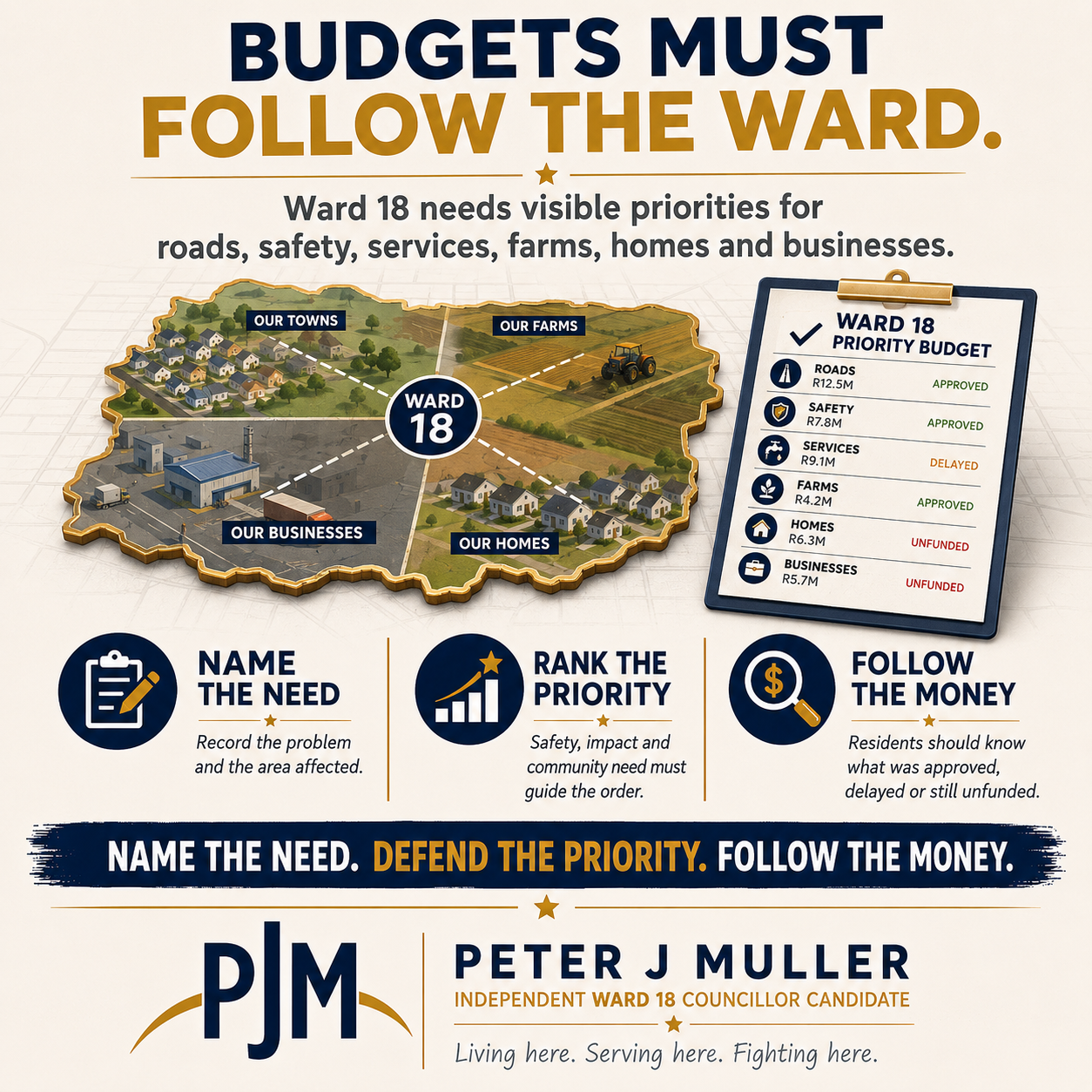
Ward-Based Budgeting: Bringing the Municipal Budget Closer to the People
By Peter J Muller
Independent Ward Councillor Candidate, Ward 18
One of the key commitments in my manifesto is a strong push for Ward-Based Budgeting. This is not a slogan, and it is not a promise that every pothole, water leak, road, park or service delivery problem will be fixed overnight. It is a practical reform aimed at making municipal budgeting more transparent, more accountable, and more responsive to the real needs of each ward.
At present, municipal budgets are usually planned and managed mainly through departments: roads, water, electricity, sanitation, parks, finance and so on. This is how municipalities have traditionally operated. While this system may work on paper, it often leaves communities asking a very fair question:
“What is actually being spent in our ward?”
Residents receive municipal accounts every month. They pay rates, taxes and service charges. Businesses contribute to the local economy. Farmers and smallholdings also rely on municipal infrastructure and access routes. Yet, when roads deteriorate, potholes remain open, water leaks continue, stormwater systems fail or streetlights stay broken, residents often cannot see where the money has gone or why their area was not prioritised.
That is where Ward-Based Budgeting can make a meaningful difference.
What is Ward-Based Budgeting?
Ward-Based Budgeting means that a clear portion of the municipal budget is linked directly to each ward’s needs, priorities and infrastructure conditions.
It does not mean that each ward becomes its own municipality. It does not mean that a ward councillor controls a separate bank account. It does not mean that normal municipal rules, supply chain processes or financial controls are bypassed.
It simply means that the budget becomes easier to track at ward level.
A ward should be able to see:
• what problems were reported;
• which problems were verified by officials;
• which projects are funded;
• which projects are not yet funded;
• what maintenance is planned;
• what has been completed;
• what still needs to be escalated.
In plain language, Ward-Based Budgeting brings the municipal budget closer to the people who experience service delivery every day.
Why this change is necessary
Many service delivery problems are not always massive, once-off capital projects. Very often they are smaller, repeated, localised failures that make daily life difficult.
A pothole that is not repaired becomes a bigger road failure.
A small water leak becomes a damaged road surface or water loss.
A blocked stormwater channel becomes local flooding.
A broken streetlight becomes a safety concern.
A neglected open space becomes a dumping site.
The current centralised system often struggles with these smaller but high-impact issues because they compete with every other issue across the entire municipality. A ward-based approach would help identify these problems earlier, prioritise them more clearly and track whether they are actually being dealt with.
This is especially important in a mixed ward such as Ward 18, which includes residential areas, business and industrial activity, smallholdings, farming areas, outlying roads and community facilities. A one-size-fits-all budgeting approach does not always reflect the reality on the ground.
Benefits for the community
The first major benefit is transparency. Residents will be able to see what is planned for their ward and what is not yet funded. This reduces confusion and helps prevent unrealistic expectations.
The second benefit is accountability. If a project is listed, there must be progress reporting. If it is delayed, the reason must be explained. If it is unfunded, the community must be told honestly.
The third benefit is better prioritisation. Communities know where the recurring problems are. Ward committees, residents, businesses and farmers can help identify practical priorities before small problems become expensive failures.
The fourth benefit is faster response to local maintenance issues. Ward-Based Budgeting can create a dedicated maintenance focus for potholes, stormwater, water leaks, streetlights, public open spaces and other ward-level problems.
The fifth benefit is fairness. A proper ward-based system can consider both need and contribution. A ward that pays well should see some visible reinvestment, but poorer areas must also be protected through fair and equitable allocation.
Benefits for the municipality
Ward-Based Budgeting is not only good for residents. It can also help the municipality.
A municipality that knows exactly where its infrastructure failures are can plan better. It can reduce emergency repairs by doing preventative maintenance earlier. It can improve public trust by showing residents what is being done. It can also strengthen revenue collection, because people are more likely to pay when they can see visible, local service delivery.
It can also help officials. Instead of receiving scattered complaints from many directions, a ward-based priority register can organise issues into a proper planning tool. This allows technical departments to work from verified data, not only from political pressure or crisis complaints.
In short, Ward-Based Budgeting can help move the municipality from reactive service delivery to planned, measurable and accountable service delivery.
What the community can expect if implemented
If Ward-Based Budgeting is implemented properly, the community should expect a more open process.
Residents should expect ward-level priority lists. They should expect regular feedback. They should expect to see which items are maintenance matters, which are capital projects, which are municipal responsibilities and which must be referred to other authorities.
The community should also expect honest reporting. Not every issue will be resolved immediately. Some projects require engineering input. Some require capital funding. Some must go through procurement. Some may depend on provincial or national departments. Some may have to wait because the municipality simply does not have enough money in that financial year.
But what should change is this: communities should no longer be left in the dark.
A problem should not disappear into a system with no feedback. It should be recorded, verified, prioritised and reported on.
What Ward-Based Budgeting will not do
It is important to be honest.
Ward-Based Budgeting will not magically fix every road, pipe, park and public facility overnight. It will not remove the need for discipline, planning, technical capacity and financial control. It will not allow councillors to hand out work to preferred contractors. It will not replace the municipality’s legal budget process.
It will also not mean that one ward keeps all the money generated in that ward. Municipalities must still operate on fairness and solidarity. Some infrastructure serves the whole town. Bulk water, wastewater treatment, electricity networks and major roads must still be funded at municipal level.
Ward-Based Budgeting is therefore not a quick fix. It is a better way of planning, tracking and accounting for limited resources.
A practical way forward
My proposal is that Dihlabeng should start with a properly designed pilot project. The pilot should identify ward priorities, link them to verified infrastructure data, allocate a realistic maintenance and micro-project budget, and then report progress publicly every quarter.
For Ward 18, this would mean a strong focus on local road maintenance, pothole management, stormwater, water network repairs, rural and smallholding access issues, public spaces, safety lighting and visible maintenance.
The goal is simple:
Residents must be able to see what is planned, what is funded, what is being done and what still needs to be fought for.
Ward-Based Budgeting is about restoring trust between the community and the municipality. It is about making the budget understandable. It is about ensuring that the voices of residents do not disappear after public participation meetings. It is about linking payment, need, maintenance and accountability in a way that people can see and measure.
We cannot fix years of infrastructure decline in one day. But we can change the way priorities are identified, funded, implemented and reported.
That is why I believe Ward-Based Budgeting is not only possible, but necessary.
It is a practical step toward a municipality that listens better, plans better, spends smarter and accounts honestly to the people it serves.
← Back to Blog
